
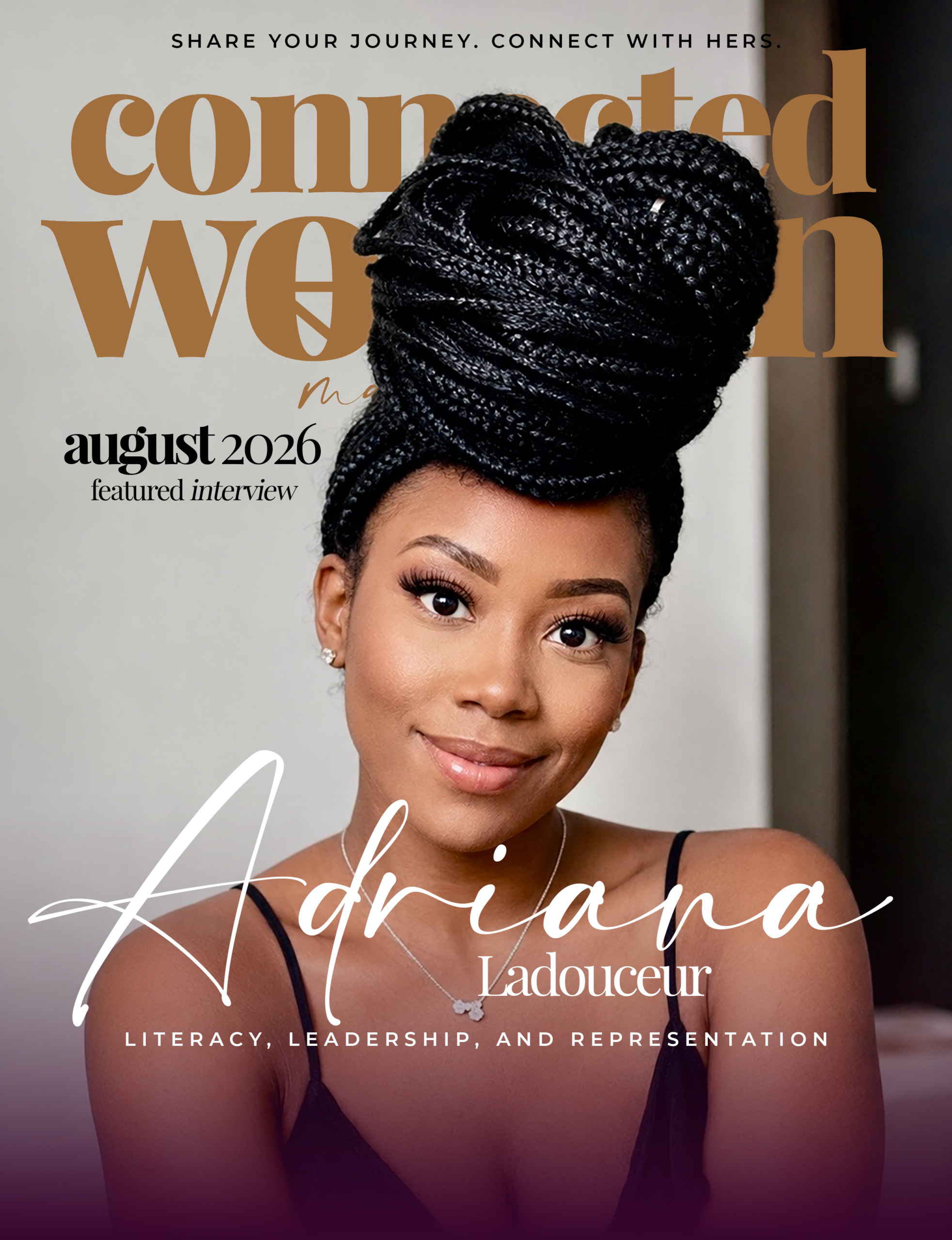
Discover how one educator is helping families, readers, and Black authors write a more inclusive and inspiring future—one page at a time.
For Adriana Ladouceur, literacy isn’t simply a professional responsibility—it’s a lifelong mission. By day, she leads an elementary school in New Jersey as a dedicated principal, shaping the educational experiences of young learners. Beyond the school walls, she is the founder of Bring Me Books, a literary media platform that celebrates Black authors, meaningful conversations, and the life-changing power of reading. In this interview, Adriana shares how she balances educational leadership with building a purpose-driven brand, why representation in literature matters, and how families and adults alike can rediscover the joy of getting lost in a great book.
As an elementary school principal, you spend your days shaping young minds, while Bring Me Books allows you to influence readers of all ages. How have these two roles informed one another, and what have they taught you about the lifelong impact of literacy?
Being a school principal has reminded me that literacy is about more than reading words on a page. It’s about building empathy and helping people understand themselves and the world around them. Whether I’m talking to an eight-year-old or an audience of tens of thousands online, my goal is the same: to help people become more curious, more empathetic, and more informed. And honestly, the numbers are really what fuel me. Reading rates in America continue to decline, and Black and Brown communities are disproportionately affected. I can’t sit back and watch that happen knowing how hard our ancestors fought for the right to read. For me, literacy is a civil rights issue.
Bring Me Books has become more than a book recommendation platform—it has grown into a space that celebrates Black authors, thoughtful dialogue, and intentional reading. What inspired you to create it, and what gap did you feel needed to be filled in the literary community?
I started Bring Me Books because I couldn’t find a space that treated Black literature as a tool for protest, joy, and community. Every year I would see “Best Books of the Year” lists that too often featured the same voices. When roughly 75% of the publishing industry is white, those gatekeepers inevitably influence who receives visibility and who doesn’t.
I wanted Bring Me Books to challenge that. I wanted Black readers to know they don’t belong on the sidelines of literary conversations. They are the conversation. They’re the main characters. Bring me Books has allowed me to amplify Black stories while fostering community and Black joy.
Many people struggle to balance demanding careers with passion projects. How have you successfully built a purpose-driven brand while serving in such a high responsibility leadership role in education, and what sacrifices or systems have made that possible?
Balance isn’t a word I deeply resonate with because there have been seasons where one demanded more than the other. What’s made it possible is having a clear mission. I know why I wake up every morning. When I’m at school, my students and staff get the very best of me. When I leave the building, Bring Me Books gets that same level of intentionality.
Summers, holidays, weekends, scheduled content, those systems allow me to build something meaningful without compromising either responsibility. Education is my profession, but literacy is my life’s work.
As both an educator and literary advocate, you’ve likely witnessed firsthand how representation in books shapes confidence and identity. Why is it so important for readers—especially children—to regularly see themselves reflected in the stories they read?
Representation tells children they belong. When young readers see themselves reflected in books, they begin imagining futures that once felt impossible. Representation also benefits readers who don’t share those identities because it builds empathy. When a child says, “That character reminds me of me,” or “I know someone like that,” that’s when literature becomes transformative. It also expands a child’s imagination. Imagine a student growing up in an inner city neighborhood reading about astronauts, scientists, or children traveling the world. Books give them permission to dream beyond the limits of what they’ve personally experienced.
The reading habits of many adults decline after they leave school. Why do you think so many people stop reading for pleasure, and what practical advice would you give someone who wants to rediscover a genuine love for books?
This one is my favorite! I think people stopped reading for pleasure after school because school never made reading fun. And if they did have a love for reading that has subsided, they just need to pick back up their favorite author or genre and the spark will be ignited again. Also, let go of the pressure to read what everyone else is reading. Pick something that genuinely interests you. Read 10 minutes before bed. Carry a book with you. Listen to audiobooks while commuting. If you want to read books with dragons, read dragons. If you want romance with all the spice, read that too. You’re not in school anymore. Read whatever you want.
Families often say they want to raise readers, but busy schedules, technology, and competing priorities can make that difficult. What are some realistic ways parents and caregivers can create a home culture where reading becomes a joyful family experience rather than another obligation?
Children imitate what they see. If parents want readers, they have to become readers too. Create moments where everyone in the house reads together, even if it’s just fifteen minutes. I am actually launching Family Book Club kits soon, this fall to help with just that! Reading should become part of family culture, not just school culture.
Through Bring Me Books, you’ve highlighted the work of numerous Black authors. What qualities or themes consistently stand out to you in their storytelling, and why do you believe these voices deserve greater visibility within mainstream literary conversations?
What consistently stands out is their willingness to tell the truth with nuance. Black authors preserve history, challenge assumptions, celebrate joy, and document experiences that have too often been overlooked. These stories aren’t niche, they’re American stories. In many ways, our history is constantly threatened with erasure. Black authors preserve that history. Their books are the receipts.
Leadership often requires continuous learning. What books have most influenced your philosophy as a school principal, and how have they shaped the way you lead students, teachers, and your broader community?
Leadership has taught me that every decision should answer one question: Does this create more opportunity for children?
Books like Discipline Is Destiny reinforced consistency over motivation. The Outliers challenged me to think differently about opportunity and access. Invisible Child by Andrea Elliott deepened my understanding of the systemic barriers many students face long before they enter a classroom. The Sum of Us reminded me that when we remove barriers for the most marginalized, everyone benefits. Those ideas influence how I lead every day.
I lead a high-performing elementary school in an underserved community where my Black and Brown students consistently outperform students from New Jersey’s wealthiest communities on the state assessment. I say that with so much pride.
We don’t work hard so our students can beat someone else’s children. We work hard because we believe our students deserve every seat at every table, college classrooms, boardrooms, courtrooms, laboratories, and beyond. We are preparing future leaders, and we’re preparing them to arrive in those spaces fully equipped to change the world.
Social media can either encourage meaningful conversations or reduce everything to quick trends. How have you intentionally cultivated Bring Me Books as a platform that prioritizes thoughtful literary discussions over simply chasing algorithms and viral moments?
I’ve never wanted Bring Me Books to be another page chasing trends. You burn out quickly if you do that. I care much more about whether a conversation changes how someone thinks than whether it goes viral. That’s why I started the series “Truth Club”. It’s where we read nonfiction – probably the least trendiest genre lol I intentionally choose books that spark reflection and ask questions that encourage dialogue rather than quick opinions. Ironically, I think authenticity performs better over time because people recognize when you’re genuinely passionate about the work. If people want the latest thriller recommendation, there are plenty of pages for that. If they want nonfiction that will change how they think about the world, they know exactly where to find me.
What have been some of the biggest challenges you’ve faced while growing Bring Me Books alongside your career in education, and how have those experiences strengthened both your leadership and your mission?
One of the biggest challenges has actually been protecting both identities. Online, people know me as energetic, funny, and passionate about books. Inside my school building, I’m responsible for making difficult decisions, coaching adults, setting expectations, and holding a very high bar for excellence. Those are two different versions of me, but they’re rooted in the same values. I don’t feel a strong need to blend those worlds because they each serve a different purpose.
Being a principal reminds me why literacy matters. Every day I see the impact reading has on children’s confidence, achievement, and futures. Bring Me Books reminds me that literacy doesn’t end when school does. Adults deserve spaces where reading is joyful, culturally relevant, and celebrated too. Somehow I’m able to give both roles everything I have because they’re both driven by the exact same mission: changing lives through literacy.
As someone who champions literacy every day, what concerns you most about today’s reading landscape, particularly among children and adults whose attention is increasingly divided by digital entertainment?
My biggest concern isn’t technology itself, it’s that we’ve become accustomed to consuming information without deeply engaging with it. Reading requires patience, focus, and critical thinking. So if you are reading on a computer, I wouldn’t mind. It’s the critical thinking piece of it that is most important. Those skills are becoming increasingly valuable in a world filled with constant distractions. We need to create environments where slowing down to think is celebrated again. My fear is that deep reading and critical thinking become skills increasingly concentrated among those with the greatest access and opportunity. That’s a future we should all be working to prevent. We have to remember that History has shown us that whenever people wanted to oppress Black communities, one of the first things they restricted was access to education. Whenever we’ve advanced, literacy has been at the center of that progress. We can’t lose that because of digital entertainment.
You’ve built a platform rooted in purpose rather than popularity. How do you personally define success for Bring Me Books, and what impact do you hope it will continue to have on readers, authors, and future generations?
You remember Reading Rainbow? That show shaped an entire generation. That’s the kind of impact I hope Bring Me Books has. People often ask me what success looks like, and it’s never been followers. Its impact. If someone picks up their first book in years because of something I shared… If an author reaches thousands of new readers… If a family starts reading together… That’s success.
I’ve had authors offer to send me gifts because of the sales they’ve seen after I featured their books. I always politely decline. Helping people discover Black stories has always been enough for me.
For aspiring creators, educators, or professionals who have an idea they’re passionate about but hesitate to pursue because of their full-time careers, what lessons from your own entrepreneurial journey would you share with them?
Don’t wait until everything is perfect before you begin. Just do it! Start with what you have, stay consistent, and let your purpose guide your decisions. Your community will find you. Building something meaningful takes time. There will always be someone with more followers or better equipment, but no one has your perspective. Focus on serving people well, and trust that the audience will come.
If you could encourage every family to adopt just one reading habit that could transform their relationship with books over time, what would that habit be, and why do you believe it has the potential to create lasting change?
Read together without a goal. No quizzes. No worksheets. No pressure. Just ten minutes a day. Children become what they consistently see. Athletes often grew up watching someone play sports. Musicians grew up surrounded by music. Readers are no different. If your children regularly see you reading, not scrolling, they’ll begin to see reading as something adults enjoy, not something teachers assign.
Looking ahead, what is your long-term vision for Bring Me Books? Beyond recommending great reads, what legacy do you hope the platform will leave in advancing literacy, celebrating Black authors, and inspiring communities to see reading as a lifelong source of growth, connection, and possibility?
Reading is an infrastructure. Every major movement for Black freedom began with someone encountering an idea in words. Before there were marches, there were books. Before there were speeches, there were essays. Before there was legislation, there was literacy. Frederick Douglass taught himself to read and later said that knowledge made him unfit to be a slave. James Baldwin challenged America with his essays. Toni Morrison preserved our humanity through fiction. Reading has always been the foundation upon which Black progress has been built.
I want Bring Me Books to become the most trusted literary media platform for Black books in the world.
How can our readers connect?
Discover more from Connected Woman Magazine
Subscribe to get the latest posts sent to your email.