
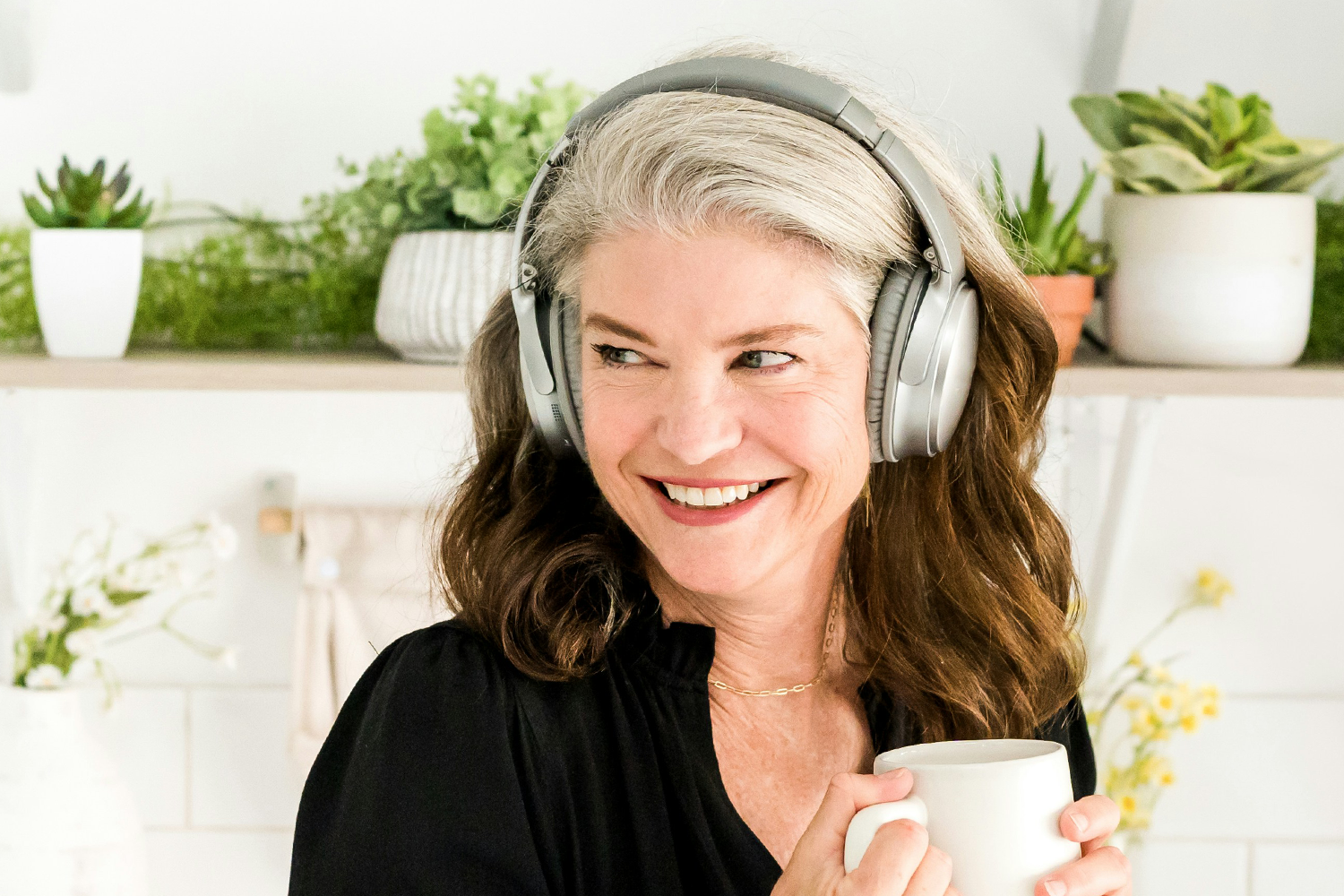
 It usually begins with one.
One suspicious silver strand standing proudly at the front of your head like it personally paid rent.
You pull it.
Another appears.
Then three.
Then twelve.
Eventually, you look into the mirror under particularly disrespectful bathroom lighting and realize:
Oh. We’re doing this now.
For some women, gray hair is no big deal.
They embrace it immediately.
They stop coloring, grow it out, get a fabulous haircut, put on red lipstick, and somehow look like they should be photographed for a luxury skincare campaign.
Then there are the rest of us.
We stare at our roots every two weeks.
We calculate how much longer we can stretch the color.
We move our part.
We buy root spray.
We strategically position headbands.
We stand in the beauty-supply aisle holding two boxes of dye while wondering whether we’re ready to stop doing this.
Growing out gray hair sounds simple.
Just stop coloring it.
Technically?
Yes.
Emotionally?
Not always.
For many women, especially women who have colored their hair for years, going gray can involve much more than changing a beauty routine. It can force us to confront aging, identity, femininity, beauty standards, workplace perceptions, cultural expectations, and our own complicated feelings about getting older.
Maybe you’re ready.
Maybe you’re absolutely not.
Maybe you stopped coloring three months ago and currently have four inches of silver roots, dark ends, and a daily urge to run back to the salon screaming:
FIX IT.
If so, welcome.
The gray-hair transition is not for the weak.
Gray Hair Has a Branding Problem
Let’s be truthful.
For generations, gray hair on men has often been described as distinguished.
Silver fox.
Mature.
Handsome.
Seasoned.
Gray hair on women?
“Are you tired?”
“Are you going to color that?”
“You’re too young to let yourself go.”
Interesting.
A man gets gray temples and apparently becomes a corporate executive in a luxury watch advertisement.
A woman gets gray temples and someone quietly hands her the number of a colorist.
Women receive endless messages that aging should be managed, concealed, delayed, corrected, tightened, injected, colored, covered, or otherwise negotiated with.
So when a woman decides to stop coloring her hair, the decision can feel surprisingly rebellious.
She isn’t simply changing her hair.
She may be deciding that visible aging is no longer an emergency.
But Let’s Not Pretend Everybody Immediately Loves Their Gray
There can be pressure on the other side too.
Once gray hair became more celebrated, another message emerged:
Embrace it! It’s empowering!
Maybe.
But you are allowed to hate yours at first.
You are allowed to look in the mirror and think:
I don’t know who this woman is.
You may feel like gray hair makes you look older.
Maybe the color is uneven.
Maybe your texture changes.
Maybe the silver is concentrated in one area while the rest of your hair is stubbornly refusing to participate.
Maybe you imagined a gorgeous white streak and instead received six random wiry hairs near your left ear.
Nature does not always follow Pinterest inspiration.
Give yourself time.
You don’t have to instantly transform every insecurity into empowerment.
The Transition Stage Can Be Rough
This is the part nobody can magically eliminate.
If you’ve been coloring your hair consistently, there will likely be a period where your natural gray is growing in while your previously colored hair remains.
Depending on your hair length, color, texture, style, and how quickly it grows, that transition can take time.
And the line of demarcation can be…obvious.
You may have gray roots.
Brown middle.
Previously dyed black ends.
Perhaps highlights from 2024 are still participating.
Your head has become a timeline.
This is where many women surrender.
They can envision the final result.
It’s the middle that gets them.
Consider working with a skilled stylist who understands gray transitions and your hair type. Depending on your situation, professional options may include strategic cuts, highlights, lowlights, blending, or other color techniques designed to soften the transition.
The best approach varies considerably depending on your existing color, hair health, texture, and desired result.
The goal doesn’t have to be getting there quickly.
It can simply be getting there without hating your hair for 18 months.
Consider Cutting It Shorter—But Only If You Want To
Some women speed up the transition by gradually cutting away previously colored hair.
Others make a dramatic chop.
This can be freeing.
It can also be terrifying if you’ve had long hair for decades.
Do not let somebody convince you that turning 50 automatically requires a short haircut.
There is no Department of Aging Women sending out mandatory pixie-cut notices.
You can wear your gray hair short.
Long.
Braided.
Natural.
Straightened.
Loc’d.
Twisted.
Curly.
In a bob.
In a ponytail.
Under a fabulous wig whenever you feel like it.
The point is not replacing one set of beauty rules with another.
The point is deciding what works for you.
Your Gray May Have a Different Texture
One surprise for some women is that gray hair may not behave exactly like the hair they’re used to.
It can feel coarser.
Drier.
More wiry.
Or simply different.
This may require adjusting your routine.
Pay attention to moisture.
Experiment with products appropriate for your texture.
Be mindful of heat use.
Ask a knowledgeable stylist for recommendations if you’re struggling with manageability.
You may also discover that your gray hair responds beautifully once you understand what it needs.
Sometimes we’re trying to force new hair to behave according to old rules.
Yellowing and Dullness Can Happen
Bright silver and white hair can sometimes develop unwanted yellow or dull tones due to factors such as product buildup, environmental exposure, heat, minerals in water, or other influences.
This is why you may see purple or violet-toned hair products marketed for gray, silver, or blonde hair.
They can be useful for some people, but more is not necessarily better.
Overuse can leave hair looking dull or even temporarily tinted.
Choose products suited to your hair and follow directions.
If you’re unsure, ask a professional.
The goal is luminous silver.
Not accidentally lavender unless lavender was the plan.
Your Wardrobe May Suddenly Look Different
This can actually be one of the fun parts.
When your hair color changes, colors you’ve worn for years may suddenly look different against your face.
Some women discover that jewel tones look spectacular with silver.
Others love black, white, cobalt blue, emerald, red, fuchsia, or rich purples.
Some find that certain neutrals they once loved now wash them out.
Experiment.
Hold colors near your face.
Try on things you normally wouldn’t.
Take photographs in natural light.
Your gray hair may create an entirely different visual contrast.
Use it.
You may find yourself becoming more adventurous with clothing because your hair has become its own accessory.
Makeup May Feel Different Too
If you wear makeup, you may find that some of your usual colors don’t have the same effect once your hair becomes gray.
This doesn’t mean you need an entirely new face.
It may simply mean experimenting.
A little more brow definition.
A different blush.
A brighter lip.
More contrast around the eyes.
Or perhaps you discover that you prefer less makeup with your gray.
There is no universal formula.
Play.
Beauty is allowed to evolve.
The Workplace Can Make Gray Hair Feel More Complicated
This deserves discussion.
Women already navigate age-related assumptions professionally.
Gray hair can make aging more visible.
Some women worry that they’ll be perceived as less current, less energetic, or closer to retirement.
Those concerns don’t appear out of nowhere.
Age bias exists.
But constantly trying to visually disguise your age can also become exhausting.
There is no correct answer.
If coloring your hair makes you feel confident professionally, color it.
If wearing your natural gray makes you feel powerful, wear it.
Your competence does not live in your hair follicles.
You should not have to look 35 forever to prove you still have something valuable to contribute.
Black Women Can Have an Especially Complicated Relationship With Gray
For Black women, hair is already layered with history, identity, politics, beauty standards, workplace expectations, texture conversations, and cultural meaning.
Adding gray to that conversation can create another dimension.
Maybe you spent years relaxing your hair.
Then went natural.
Then started wearing protective styles.
Then decided to embrace your curls.
Now your curls are turning silver and you are once again learning a new version of your own hair.
Gray can look stunning against melanated skin.
Silver locs.
Salt-and-pepper curls.
Gray braids.
White twists.
A silver afro.
A dramatic gray streak.
There is something powerful about Black women allowing themselves to visibly age in a culture that too often celebrates youth while overlooking the beauty, wisdom, style, and presence of older women.
But again, you don’t owe anybody gray hair as a political statement.
You can love being Black.
Love being over 50.
Love yourself.
And still have a standing color appointment every four weeks.
Freedom means choice.
Be Prepared for Everyone to Have an Opinion
The minute you start growing out your gray, people may comment.
“Are you going gray?”
Yes, Patricia.
That appears to be what is happening.
“I would never let mine go.”
Congratulations.
“You look older.”
Thank you for that completely unnecessary observation.
“I love it!”
We appreciate you.
Some people will genuinely admire it.
Some will project their own fears about aging onto you.
Some will try to convince you to color it.
Others will insist you should never color again.
Remember:
They do not have to wear your hair.
You do.
Do Not Confuse Gray With Giving Up
This is one of the most damaging ideas.
A woman stops coloring her hair and suddenly she has “let herself go.”
Why?
Maybe she has actually let something else go.
The expense.
The maintenance.
The chemical processing.
The root anxiety.
The four-week salon schedule.
The belief that gray hair automatically needs correction.
Maybe she has not given up at all.
Maybe she has simply decided she no longer considers gray hair a problem.
There is a difference.
But If You Want to Color It, Color It
This article is not a recruitment campaign for the Silver Hair Society.
If you love your dark hair, keep it.
If you enjoy being blonde, stay blonde.
If you want copper, burgundy, blue, purple, or hot pink, do that.
You are not less evolved because you color your gray.
You are not insecure because you enjoy hair color.
The point of embracing aging should not be creating new rules women must follow to prove they have embraced aging.
Maybe embracing yourself means going completely silver.
Maybe it means covering every gray strand until you’re 93.
Maybe it means switching between both.
Your hair.
Your choice.
Take Pictures During the Transition
If you decide to grow your gray out, document it.
The transition can feel painfully slow when you’re looking at yourself every day.
Take monthly photos.
Same lighting if possible.
Same angle.
You’ll begin noticing progress you can’t see day to day.
Three months.
Six months.
Nine months.
A year.
One day, you may realize there is more natural hair than colored hair.
Then eventually the last of the old color gets cut away.
That moment can feel surprisingly emotional.
You’re looking at hair you haven’t fully seen in years.
Maybe decades.
Find Inspiration That Actually Looks Like You
Representation matters.
If you’re considering gray hair, search for women with similar skin tones, textures, face shapes, and styles.
Look for gray-haired women who are stylish in ways that resonate with you.
Not just models.
Real women.
Women in their 40s.
50s.
60s.
70s.
80s.
Women with curls.
Locs.
Braids.
Straight hair.
Short cuts.
Long hair.
Seeing beautiful women confidently wearing gray can help you imagine possibilities beyond the outdated image of what gray hair supposedly represents.
Give Yourself Permission to Change Your Mind
You grow your gray for eight months.
Then you hate it.
Color it.
You color it for another year.
Then you’re tired of maintenance again.
Grow it.
You are allowed to change your mind.
Hair is deeply personal, but it is also hair.
This does not have to become a lifelong philosophical commitment.
Experiment.
Adjust.
Try something else.
There is no Gray Hair Police coming to revoke your membership.
Maybe the Real Struggle Isn’t the Hair
Sometimes the gray is simply making something else visible.
Time.
You look into the mirror and realize:
I’m getting older.
That realization can carry grief.
You remember your younger face.
Your younger body.
The years that passed quickly.
People you’ve lost.
Choices you made.
Things you haven’t done yet.
Gray hair can become a visible marker of time in a society that often encourages women to pretend time isn’t happening.
But aging is not a personal failure.
Getting older means your appearance will change.
That can be difficult.
It can also become an invitation to develop a relationship with beauty that has enough room for evolution.
You don’t need to look like your 30-year-old self at 55.
You can look like a beautiful 55-year-old woman.
Or 65.
Or 75.
That doesn’t mean every change will be easy to accept.
It means you stop requiring yourself to remain visually frozen in another decade.
There Is Something Beautiful About Seeing Yourself Emerge
Eventually, the transition may end.
The old color is gone.
Your natural gray has taken over.
You look in the mirror.
Maybe it isn’t the shade you expected.
Maybe it’s darker.
Brighter.
More silver.
More salt-and-pepper.
Maybe one side is grayer than the other because apparently your follicles do not believe in symmetry.
But it’s yours.
And perhaps you realize something.
You didn’t disappear when your hair turned gray.
You are still stylish.
Still attractive.
Still feminine.
Still sexy.
Still creative.
Still professional.
Still relevant.
Still you.
Only now, you don’t have to panic every time your roots appear.
Maybe you feel freer.
Maybe you feel older.
Maybe you feel both.
That’s okay.
Embracing gray hair does not require pretending you are thrilled about every aspect of aging.
It can simply mean deciding that aging no longer needs to be hidden in order for you to feel beautiful.
And if tomorrow you decide you want to dye it?
Buy the color.
Beauty should be something you participate in—not a set of rules you spend your life trying to obey.
Your Turn
Are you currently growing out your gray hair, already fully silver, still coloring every root, or standing somewhere in the middle wondering what you want to do?
What has been the hardest part of the transition—the awkward grow-out stage, texture changes, seeing yourself look different, comments from other people, workplace concerns, or simply accepting visible signs of aging?
Share your gray-hair experience in the comments. Tell us what helped you embrace it, what products or styling changes worked for you, whether you eventually went back to color, and what you wish another woman knew before beginning the transition. Your story may be exactly what another woman needs while she’s standing in the mirror staring at three inches of gray roots wondering, Do I keep going—or do I call my stylist right now?Discover more from Connected Woman Magazine
Subscribe to get the latest posts sent to your email.