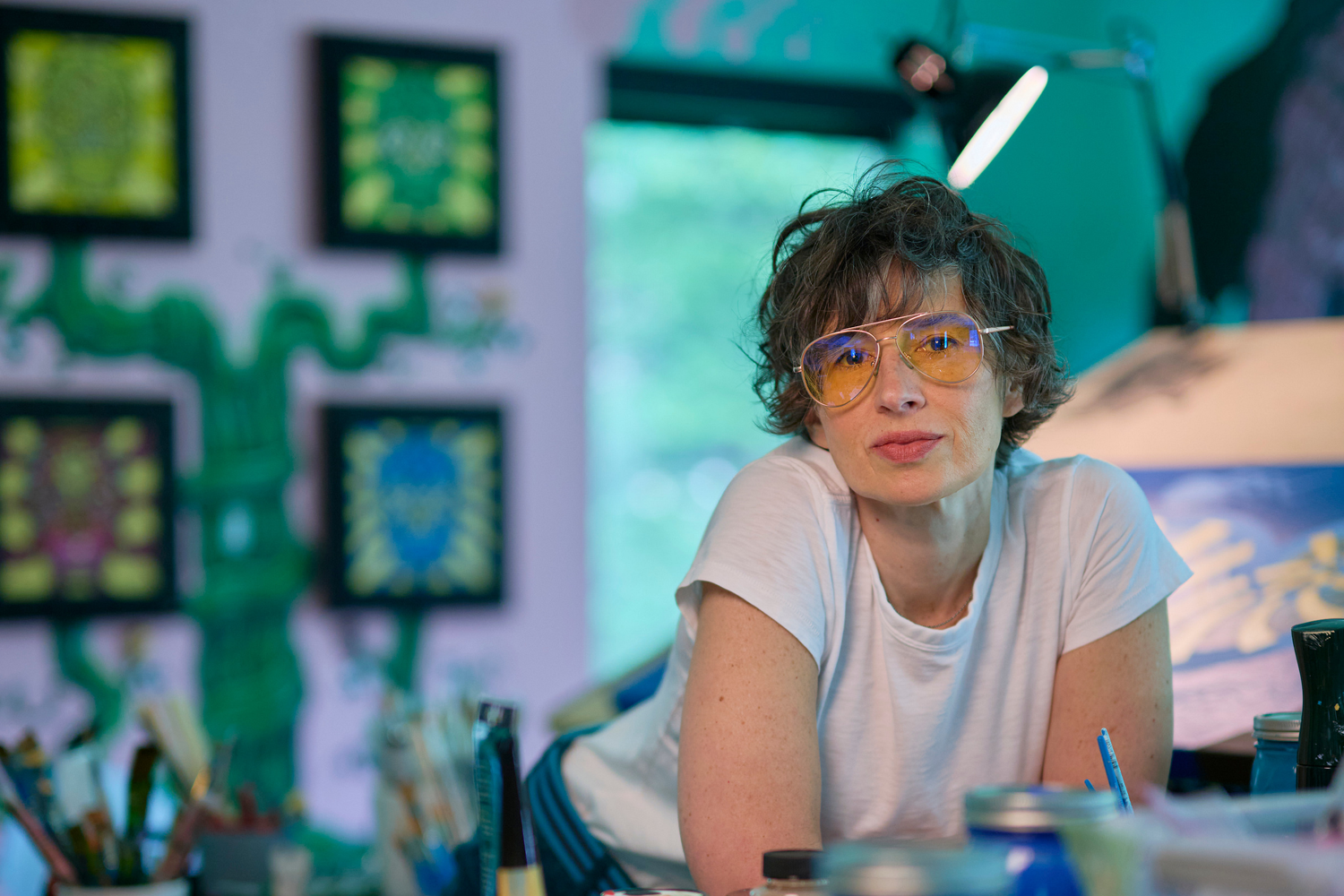
From floor-to-ceiling art to deeply intimate illustrated diaries, JFo is turning the landscapes of her inner world into stories others can see themselves in.
For JFo, creativity isn’t simply something she does—it is an essential part of how she experiences, understands, and expresses the world. A naturally gifted illustrator and painter, author, certified Grief Educator, and co-owner of J & J Publishing House, JFo has spent a lifetime following an imagination that refuses to be contained. From discovering later in life that she is on the Autism Spectrum to navigating the devastating loss of her mother and transforming that grief into her upcoming illustrated diary, Grief Monster, her journey is one of radical authenticity, self-discovery, love, and creative expression. In this conversation, we meet the woman beyond the pages and explore the experiences that have shaped her art, her identity, and the deeply personal stories she is now ready to share with the world.
Your creative journey has been entirely self-directed, from drawing as a child to painting larger-than-life murals and now authoring Grief Monster. Looking back, what has trusting your own artistic instincts taught you that formal training may never have offered?
I used to be jealous of people who had the opportunity to go to art school and learn all the things it offers. And even though sometimes I think it would be nice to know what I’m doing, I wouldn’t want it any other way—I’m free to do whatever I want without being restricted by should’s or what’s right or wrong. I don’t care much anymore if someone tells me I’m doing something wrong. How it feels when I’m creating it is all that matters, and I’ve found that the art I make from that honest place is the work that touches people the most.
Grief Monster blends inmate writing with striking illustrations in a way that feels almost inseparable. How did you know that words alone couldn’t tell this story, and what role did the artwork play in expressing emotions that language simply couldn’t reach?
All of the diary entries started as illustrations, and because of their nature, they were very emotionally charged. Each entry is a raw expression of the moment of grief that inspired it. Sometimes that moment was unique, sometimes it was recurring, and sometimes it was an energy that encompassed weeks, months, or more. I would feel the Grief Monster’s energy while or after drawing it, and I would close my eyes to narrow in on what they were saying to me or what they were making me feel. That’s how the dialogue between the Grief Monster and me came to be a part of the entries.
As a certified Grief Educator through David Kessler, you’ve studied grief professionally while also experiencing it personally. How do those two perspectives complement—and sometimes challenge—each other in your work?
Visiting David Kessler’s grief.com was recommended to me a few months after losing my mother. I watched his “Tender Hearts” videos almost daily—each one felt like it gave me more room to breathe. I never intended to become an educator professionally—I just couldn’t get enough of the information! And now I’m so happy I completed the certification because the world needs to learn about grief in order to heal, and sharing my personal journey through Grief Monster feels like answering that call for help.
Society often expects grief to follow a timeline or eventually “end.” Through Grief Monster, what misconceptions about grief are you hoping to dismantle once and for all?
I hope to dismantle the belief in a “finish line” being any part of the grieving process. The anticipation of it “ending” sets us up for disappointment, failure, shame, confusion, isolation, and so many more unnecessary and terrible feelings. Good days are real and wonderful in the midst of grief, but when you interpret them through the lens of it “being over,” it’s like constantly waiting for the other shoe to drop. When you understand that grief is a process and the emotions come in waves, you can move through it moment to moment, taking it as it comes—you can learn to be gentle and compassionate with your own unique process.
The title itself—Grief Monster—is powerful and evocative. Why did you choose to personify grief in this way, and how has your own relationship with that “monster” evolved over time?
I’ve always loved drawing monsters—they’ve always been the most natural thing for me to draw. I feel like our dark sides, including my own, look like monsters—but also silly. My monster drawings usually have humor in them, because that’s how it feels to me—from a high enough perspective, our monsters are silly—our dark sides are just inflated, fearful parts we think are real. At the true core of everything is pure love. Maybe in 100 years our “grief monsters” will look different. Maybe I’ll reincarnate and draw them.
Receiving a late-in-life Autism Spectrum diagnosis can reshape a person’s understanding of their entire life story. How has that discovery reframed your creativity, your relationships, and your sense of identity?
I discovered I am Autistic at age 51, and that reframed every aspect of my life. As far as my creativity goes, I know now that it can no longer be treated as a leisure activity or hobby—it is my purpose, and it deserves my attention, time, and energy on a regular basis. Not to mention it is my primary regulation tool. Regarding relationships, the diagnosis explained so much of why I find relationships so difficult. Since I am technically still coming out of Autistic Burnout (induced by the late-diagnosis—Illustrated Diary in the works), I don’t know who I really am yet. My entire life pre-diagnosis was spent masking the autism, and since the diagnosis, I’ve been in burnout. I know I won’t be able to maintain the relationships I once had unless those people take the time and energy to get to know the real me. And as I learn to take care of myself, I learn that it’s not optional—it’s life or death for me to stay regulated as often as possible. And God bless my wife—she puts in the time and care to learn who I am and what I need to be peaceful. Those are the only types of relationships I can make room for now. I’m still learning to shed 50 years of masking mechanisms, but I am learning who I truly am and allowing that to bring me peace and joy…and freedom. My creations are the manifestation of that.
You describe your imagination as both natural and necessary. Has creating art always been your primary language for processing life’s most profound experiences, and how has that relationship changed over the years?
I have drawn since I could hold a pencil, literally. My mother used to take away my pencil so I could go to sleep. Whatever desk job I had, I drew in secret constantly. My relationship to drawing has been reborn since my mother’s death—it’s become less of a pastime and more purposeful. These diary entries reminded me how magnificent it feels to express myself through art instead of just making it because I’m good at it. Grief Monster opened a pandora’s box in a way—I can never go back to making art that isn’t an authentic expression of my Self in some way.
Authenticity is a recurring theme in both your life and your work. In a world that often rewards polished narratives, what has it taken for you to remain unapologetically honest in your art?
Well, I wasn’t always authentic with my art. When I was in my 20s, people criticized my drawings. Friends, family, and coworkers urged me to “lighten up” my illustrations—so being young and unknowing, I started drawing things people liked—cute and funny and silly things. But my mother’s death cracked me wide open, and I reclaimed my artistic truth through the process. Now I’m illustrating a diary of late-diagnosis, which is even more gritty, and I’m having the time of my life. I will never hold myself back again—my artistic freedom of expression is everything.
Readers often connect deeply with artists who are willing to expose vulnerability. Was there a moment while creating Grief Monster when you questioned whether the material was simply too personal to publish?
Absolutely. I had several moments of questioning. One was sharing the intimate details of my mother’s final moments—of her death. I still wonder how that will be received by my family members. Ultimately, I chose to share it because death doesn’t happen like it does in the movies—and it can be very traumatizing and isolating when someone you love has the type of death that you never thought would “happen to them.” The truth is that it’s very rare to experience death all tied up in a bow—it’s much more common for it to be messy and traumatizing and filled with loose ends and unsaid words. Maybe if I share my story, someone will feel less alone or less lied to—and that’s why I chose to share it.
As co-owner of J & J Publishing House, you’re helping shape a publishing company built around intention, love, and meaningful storytelling. What kinds of books do you hope your publishing house becomes known for over the next decade?
Very simply, I hope our books become known most as avenues to self-love. It is truly the first step to all good things, and so many of us skip it or ignore it entirely. You must fill your own cup first—then, and only then, can you truly help others.
You and your wife, JC Wilde, have built both a marriage and a creative partnership. How do the two of you encourage one another’s growth while protecting each other’s individual artistic voices?
Encouraging each other’s growth is the backbone of our relationship—creatively, professionally, and relationally…in all ways, really. We both understand that creativity is not a hobby; it’s a way of purposefully living a fulfilling life. We are constantly collaborating, critiquing (with love), and supporting each other’s creations. And we also know when to protect the creation, like in early stages. We’ll say, “I want to share this with you, but just to celebrate a new idea. I don’t want any feedback.” It’s important to say what you need at any particular moment, whether it’s support or feedback or silence—sometimes you just need to talk something out, and hearing yourself is enough. It’s an exciting dynamic to live inside of, and it’s also delicate, so boundaries and clear communication are really key. We’re both pretty fiery, so protecting our own artistic voice is fairly easy. Sometimes it’s making enough room in our own imagination to hear a different perspective that’s tricky—but it almost always leads to an expansion of the project. Learning to listen when you want to talk is a profoundly helpful relational tool.
Your interests span metaphysics, the afterlife, cryptids, classic Hitchcock films, and spirituality. How do these seemingly different fascinations intersect within your creative process and influence the stories you choose to tell?
Most of my interests fall under the umbrella of “metaphysical.” I like to say I live “in the woo.” I’m not sure how Alfred Hitchcock films got in there, but I recently read something that said he was Autistic (unofficially, I’m sure), so maybe that’s why I’m so attracted to the way he sees and frames the world. My special interests intersect with my creations in ways I wonder if anyone will see. For example, in all the paintings I’ve done over the last few years, there’s a UFO somewhere. Many of my creatures have third eyes. I hide ancient Egyptian symbols for Love and Oneness and things like that in all of my work…even if I paint over it. Sometimes I wonder if that’s why certain people feel so drawn to my work—subconsciously and energetically, they may feel the high vibrations of such things.
Beyond Grief Monster, you’ve shared plans to create additional Illustrated Diaries documenting your journey with autistic burnout and your Autism Spectrum diagnosis. What conversations do you hope those future books will begin?
Yes, I’m regularly illustrating diary entries regarding both my late-diagnosis/burnout, and AuDHD—what the neurodivergent community calls the intersection of Autism and ADHD, which is very common. I hope that these future diaries open the door to conversations and understanding about neurodivergence and the autism spectrum. The more I learn about myself, the more I see these traits in those around me. Because of my diagnosis, I am able to get help and answers and resources to make my life better and easier. Without an understanding of these neurological differences, people continue to white-knuckle through their days, like I did, leading to chronic pain, burnout, and worse. The world was not designed for neurodivergence, or even with it in mind. And the more light we shed on these differences, the better the world will be for more people. These projects are very important to me, and I’ve decided to put it all out there—the more embarrassing things feel, the more I am including it in the diary with the intention of shedding a light on this reality. I want to create a safe space so we can eliminate fear around being true to yourself and meeting your own needs. No more jamming a square peg into a round hole until “it fits.” We are built differently, not deficiently.
For readers who have spent years feeling unseen in their grief, what do you hope they experience emotionally when they recognize themselves within the pages of Grief Monster?
I hope readers feel seen and that their grief feels witnessed. I hope they realize they are not alone, they are not crazy or broken. I hope they feel loved and supported. I hope they feel inspired to care for themselves and see miracles where they didn’t before. I hope their hearts feel lighter in the connection to something greater.
If someone closes Grief Monster feeling just a little less alone than they did before they opened it, what would that mean to you personally as both an artist and a human being?
Making this book wasn’t only a physical and professional endeavor; it was emotionally taxing, revisiting the entries over and over as the stages of production progressed. If someone closes this diary feeling less alone, then it would truly make it all worthwhile. Knowing that sharing my journey played a part in the healing of another’s heart would validate its existence. This is my greatest wish for the book…to help shed light on the reality of grief, and to play a role in healing the hearts of the world.
How can our readers connect?
Web: https://www.jjpublishinghouse.com
IG: https://www.instagram.com/j.and.j.publishinghouse/
Continue the Conversation
There’s more to this story. Continue exploring our special three-part series featuring JFo and JC Wilde, the creative forces behind J & J Publishing House. From the deeply personal story behind Grief Monster to conversations about creativity, healing, self-discovery, love, and building a purpose-driven publishing house, each interview offers another layer of their journey. Be sure to check out the other posts in the series and experience the full conversation.
Discover more from Connected Woman Magazine
Subscribe to get the latest posts sent to your email.