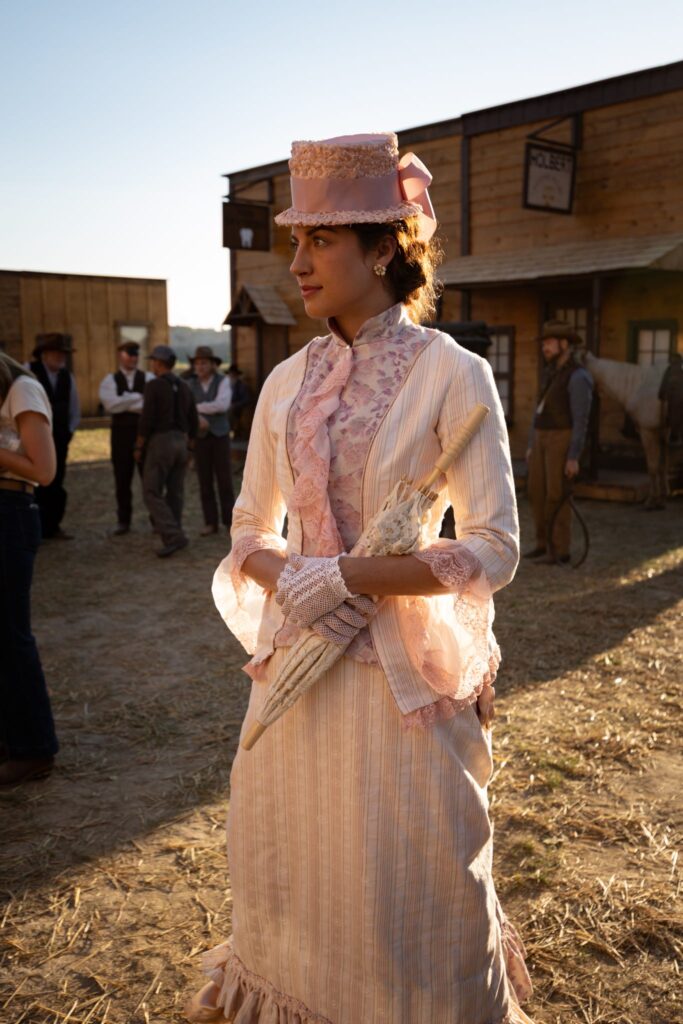
 This story is rooted in ambition, resilience, and survival in the Dakota Territory. What parallels, if any, did you find between Medora’s journey and your own path in the film industry?
I found a surprising parallel in the idea of devotion. Medora’s devotion to her husband reminded me of the devotion we have as artists to our craft. There is a kind of faith required, a willingness to stay committed through uncertainty, through struggle, through moments where the outcome is not guaranteed.
Filmmaking asks that of you. It asks you not to give up, to keep going, and to trust that if you are on the path you are meant to be on, something will come of it. In that way, her story felt incredibly modern to me. The details may belong to the 1800s, but the emotional truth is timeless.
You’re set to star alongside Julianna Margulies in Penny, a project you’re also directing. What has it been like stepping into a dual role opposite such an accomplished actress, and how has that dynamic shaped the film?
Working with Julianna Margulies has been transformative. She has become a true mentor to me, not only in craft but in confidence. She completely trusted me as a director and as a creative partner, and that kind of trust allows you to step into your own voice in a deeper way.
As an actor, she brings such honesty and precision that it elevates every moment. As a collaborator, she made me better. She helped me trust my instincts and stand firmly in my vision. It made me realize how important it is to work with artists who challenge you while also supporting you. I would love to continue working with legends like her throughout my career.
With multiple projects like Run Honey Run and Timber Lands now completed, how do you decide which stories are worth your time and creative energy at this stage in your career?
I am drawn to stories that feel alive in me. The ones that linger, that I cannot ignore. I also love stories that feel a bit surprising, characters who could exist in any generation and still feel relatable.
With Run Honey Run, I really wanted to have fun and break some rules. It leans into a more playful, unexpected tone. You will see characters breaking the fourth wall, singing, crying, shifting between humor and emotion in a way that feels a little uncontained. That freedom was important to me. It reminded me that storytelling does not always have to stay within the lines to feel truthful.
At this stage, I am choosing stories that feel timeless, stories that could live beyond a specific moment and still resonate. I am especially drawn right now to projects told through a female point of view, and I would love to step into another period piece or an action-driven film in the near future.
This story is rooted in ambition, resilience, and survival in the Dakota Territory. What parallels, if any, did you find between Medora’s journey and your own path in the film industry?
I found a surprising parallel in the idea of devotion. Medora’s devotion to her husband reminded me of the devotion we have as artists to our craft. There is a kind of faith required, a willingness to stay committed through uncertainty, through struggle, through moments where the outcome is not guaranteed.
Filmmaking asks that of you. It asks you not to give up, to keep going, and to trust that if you are on the path you are meant to be on, something will come of it. In that way, her story felt incredibly modern to me. The details may belong to the 1800s, but the emotional truth is timeless.
You’re set to star alongside Julianna Margulies in Penny, a project you’re also directing. What has it been like stepping into a dual role opposite such an accomplished actress, and how has that dynamic shaped the film?
Working with Julianna Margulies has been transformative. She has become a true mentor to me, not only in craft but in confidence. She completely trusted me as a director and as a creative partner, and that kind of trust allows you to step into your own voice in a deeper way.
As an actor, she brings such honesty and precision that it elevates every moment. As a collaborator, she made me better. She helped me trust my instincts and stand firmly in my vision. It made me realize how important it is to work with artists who challenge you while also supporting you. I would love to continue working with legends like her throughout my career.
With multiple projects like Run Honey Run and Timber Lands now completed, how do you decide which stories are worth your time and creative energy at this stage in your career?
I am drawn to stories that feel alive in me. The ones that linger, that I cannot ignore. I also love stories that feel a bit surprising, characters who could exist in any generation and still feel relatable.
With Run Honey Run, I really wanted to have fun and break some rules. It leans into a more playful, unexpected tone. You will see characters breaking the fourth wall, singing, crying, shifting between humor and emotion in a way that feels a little uncontained. That freedom was important to me. It reminded me that storytelling does not always have to stay within the lines to feel truthful.
At this stage, I am choosing stories that feel timeless, stories that could live beyond a specific moment and still resonate. I am especially drawn right now to projects told through a female point of view, and I would love to step into another period piece or an action-driven film in the near future.
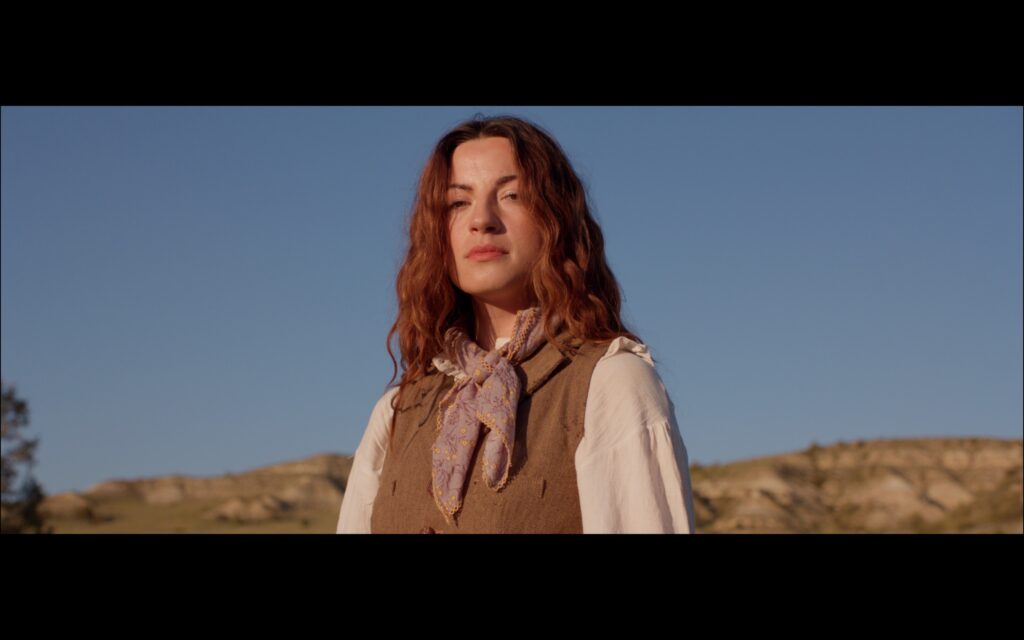
Westerns often explore themes of survival, morality, and identity. How do you approach these themes in a way that feels fresh and relevant for modern audiences? I approach them through specificity and emotional truth. If the characters feel real, the themes will feel relevant regardless of the time period. I am less interested in recreating the past perfectly and more interested in finding what is universal within it. For me, it is about creating characters who feel like individuals, not archetypes. People who could exist now or a hundred years ago and still feel recognizable. I am especially interested in exploring these themes through a female point of view, and finding stories that feel both grounded and expansive, whether they live in the past or in something more action driven.
Watch the Medora Trailer here
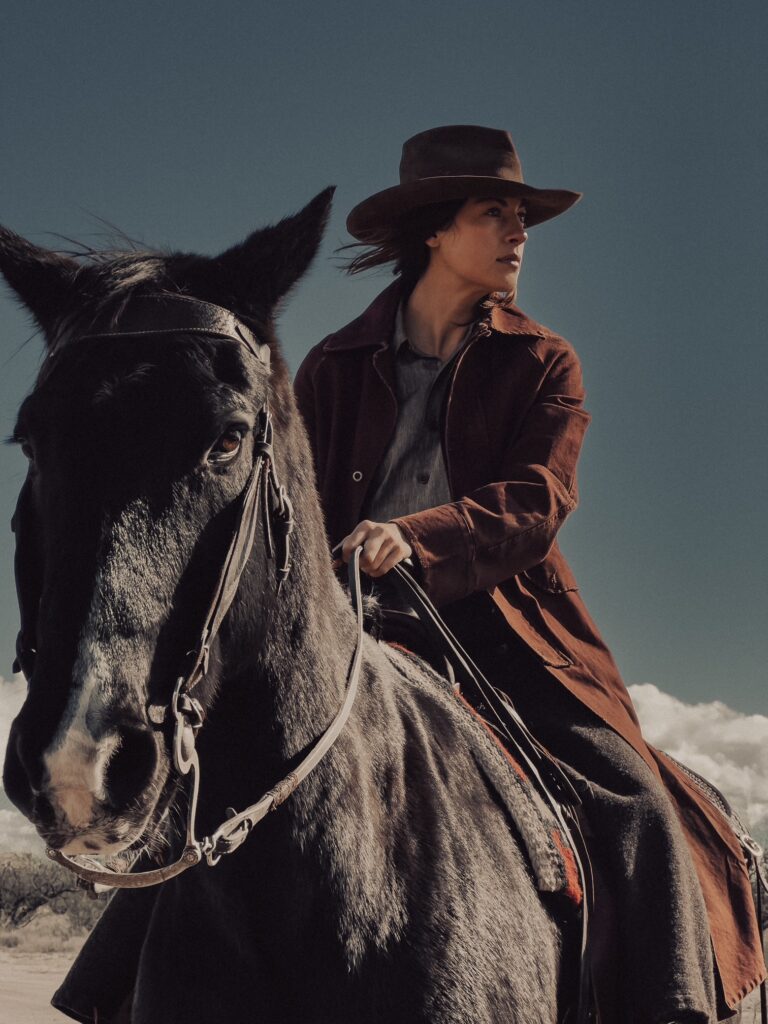 As someone with expert-level horseback riding skills and dialect versatility, how do these physical and technical abilities influence the types of roles you pursue or create?
Those skills give me access to worlds that feel grounded and authentic. They allow me to move through these environments with confidence, which frees me up to focus on the emotional work.
But ultimately, they are tools in service of the story. What matters most to me is the humanity of the character. I am always looking for roles that allow me to combine that physicality with something emotionally rich, especially in period pieces or more action driven work.
Your work often highlights strong, complex female characters in traditionally male-dominated Western narratives. How intentional is that, and what kind of impact do you hope it has?
It is very intentional. I want to show that strength does not always look the same. Sometimes it is loud and forceful, and sometimes it is quiet, patient, and rooted in devotion.
Medora reminded me that there is power in choosing love, in standing beside someone, in enduring. I hope that by showing different versions of strength, it opens the door for more nuanced and honest representations of women in this genre, and encourages more stories to be told through a female lens.
As the director, co-writer, and producer of Last Tour Home, what did that experience teach you about balancing creative vision with the logistical demands of filmmaking?
It taught me that filmmaking requires its own kind of devotion. You have to stay committed to the story while navigating constant challenges. There is no perfect set of circumstances. You just keep going.
That experience reinforced the importance of trusting your instincts and surrounding yourself with people who believe in the same vision. It also made me more intentional about the kinds of stories I want to tell moving forward, especially ones that feel personal and grounded in a strong point of view.
When you’re wearing multiple hats on a project, how do you protect your creative instincts while also making objective decisions as a director and producer?
I try to stay connected to the original feeling that inspired the story. That becomes my compass. Even when I have to make practical decisions, I check them against that feeling.
It is a constant balance, but I have learned to trust that instinct more and more. I also try to stay open to discovery, which allows the work to evolve into something even stronger than what I initially imagined.
As someone with expert-level horseback riding skills and dialect versatility, how do these physical and technical abilities influence the types of roles you pursue or create?
Those skills give me access to worlds that feel grounded and authentic. They allow me to move through these environments with confidence, which frees me up to focus on the emotional work.
But ultimately, they are tools in service of the story. What matters most to me is the humanity of the character. I am always looking for roles that allow me to combine that physicality with something emotionally rich, especially in period pieces or more action driven work.
Your work often highlights strong, complex female characters in traditionally male-dominated Western narratives. How intentional is that, and what kind of impact do you hope it has?
It is very intentional. I want to show that strength does not always look the same. Sometimes it is loud and forceful, and sometimes it is quiet, patient, and rooted in devotion.
Medora reminded me that there is power in choosing love, in standing beside someone, in enduring. I hope that by showing different versions of strength, it opens the door for more nuanced and honest representations of women in this genre, and encourages more stories to be told through a female lens.
As the director, co-writer, and producer of Last Tour Home, what did that experience teach you about balancing creative vision with the logistical demands of filmmaking?
It taught me that filmmaking requires its own kind of devotion. You have to stay committed to the story while navigating constant challenges. There is no perfect set of circumstances. You just keep going.
That experience reinforced the importance of trusting your instincts and surrounding yourself with people who believe in the same vision. It also made me more intentional about the kinds of stories I want to tell moving forward, especially ones that feel personal and grounded in a strong point of view.
When you’re wearing multiple hats on a project, how do you protect your creative instincts while also making objective decisions as a director and producer?
I try to stay connected to the original feeling that inspired the story. That becomes my compass. Even when I have to make practical decisions, I check them against that feeling.
It is a constant balance, but I have learned to trust that instinct more and more. I also try to stay open to discovery, which allows the work to evolve into something even stronger than what I initially imagined.
 Can you walk us through your storytelling process from the initial idea to the final cut? Where do you feel most creatively challenged and most at home?
It usually begins with a feeling. Something emotional that I want to explore. From there, it becomes about building characters who can carry that feeling.
My directing process is very rooted in play. I like to create an environment where actors feel free to explore, to surprise themselves, to stumble into something unexpected. When the pressure is off finding a manufactured beat, something more honest tends to emerge. Those are often the moments that make it into the final cut.
I feel most at home in that space, working with actors, discovering something together in real time. As an actor myself, I know how important that freedom is. The most challenging part is letting go at the end, trusting that the story has become what it needed to be. I am always drawn to stories that allow for that kind of exploration, especially those rooted in a strong female perspective or set within rich, immersive worlds.
As a filmmaker, how do you approach world-building, particularly in Western or period-inspired settings where authenticity is crucial?
I approach it through the lens of emotional authenticity. The details matter, but they are there to support the story, not define it.
I want the world to feel lived in, but I care most that the characters feel real within it. That is what makes an audience believe. I am especially drawn to building worlds that feel timeless, where the emotional experience can translate across generations.
Growing up in Ashland, Oregon and training in ballet, how did those early artistic influences shape your approach to performance and storytelling?
Those experiences gave me a deep appreciation for discipline and expression. Ballet taught me how to communicate through movement, and growing up around storytelling in Ashland shaped my understanding of character and narrative.
They both continue to influence the way I approach my work today, especially in how I think about rhythm, physicality, and emotional expression.
Your path includes athletics, dance, and formal acting training at The Barrow Group. How have these diverse disciplines informed your work ethic and creative perspective?
They taught me resilience and consistency. There is a commitment required in all of those disciplines that carries into filmmaking.
They also taught me to stay grounded in truth, which is something I carry into every performance and every project I direct. That foundation continues to guide me as I take on new challenges and explore different kinds of storytelling.
As you continue to build your career both in front of and behind the camera, what kind of stories do you feel most called to tell and what legacy do you hope to leave in the film industry?
I feel called to tell stories that are rooted in emotion. Stories inspired by something deeper, whether that is love, justice, revenge, devotion, or ambition.
I want to be part of projects that can live on, that my future children could watch and feel something from. Stories that last.
If there is a legacy, I hope it is one of honesty and heart. That I stayed devoted to this path, no matter how difficult it was, and that I helped create space for stories told through a female point of view, whether they live in the past, in a period piece, or in something bold and action driven.
Can you walk us through your storytelling process from the initial idea to the final cut? Where do you feel most creatively challenged and most at home?
It usually begins with a feeling. Something emotional that I want to explore. From there, it becomes about building characters who can carry that feeling.
My directing process is very rooted in play. I like to create an environment where actors feel free to explore, to surprise themselves, to stumble into something unexpected. When the pressure is off finding a manufactured beat, something more honest tends to emerge. Those are often the moments that make it into the final cut.
I feel most at home in that space, working with actors, discovering something together in real time. As an actor myself, I know how important that freedom is. The most challenging part is letting go at the end, trusting that the story has become what it needed to be. I am always drawn to stories that allow for that kind of exploration, especially those rooted in a strong female perspective or set within rich, immersive worlds.
As a filmmaker, how do you approach world-building, particularly in Western or period-inspired settings where authenticity is crucial?
I approach it through the lens of emotional authenticity. The details matter, but they are there to support the story, not define it.
I want the world to feel lived in, but I care most that the characters feel real within it. That is what makes an audience believe. I am especially drawn to building worlds that feel timeless, where the emotional experience can translate across generations.
Growing up in Ashland, Oregon and training in ballet, how did those early artistic influences shape your approach to performance and storytelling?
Those experiences gave me a deep appreciation for discipline and expression. Ballet taught me how to communicate through movement, and growing up around storytelling in Ashland shaped my understanding of character and narrative.
They both continue to influence the way I approach my work today, especially in how I think about rhythm, physicality, and emotional expression.
Your path includes athletics, dance, and formal acting training at The Barrow Group. How have these diverse disciplines informed your work ethic and creative perspective?
They taught me resilience and consistency. There is a commitment required in all of those disciplines that carries into filmmaking.
They also taught me to stay grounded in truth, which is something I carry into every performance and every project I direct. That foundation continues to guide me as I take on new challenges and explore different kinds of storytelling.
As you continue to build your career both in front of and behind the camera, what kind of stories do you feel most called to tell and what legacy do you hope to leave in the film industry?
I feel called to tell stories that are rooted in emotion. Stories inspired by something deeper, whether that is love, justice, revenge, devotion, or ambition.
I want to be part of projects that can live on, that my future children could watch and feel something from. Stories that last.
If there is a legacy, I hope it is one of honesty and heart. That I stayed devoted to this path, no matter how difficult it was, and that I helped create space for stories told through a female point of view, whether they live in the past, in a period piece, or in something bold and action driven.
Discover more from Connected Woman Magazine
Subscribe to get the latest posts sent to your email.