
 At the intersection of advocacy, equity, and healing, Ashley McGirt-Adair is redefining what accessible mental health care truly looks like. As a licensed psychotherapist, international speaker, and founder of the Therapy Fund Foundation, her work is deeply rooted in addressing the disparities that leave underserved communities navigating trauma without support. What began as a personal mission—shaped by the loss of her grandmother and the painful reality of limited access to care—has evolved into a powerful movement providing free therapy while ensuring clinicians are valued and fairly compensated. In this conversation, Ashley shares the heart behind her work, the intentional model she built to balance equity for both clients and providers, and why she believes healing should never be treated as a luxury, but as a necessity every community deserves. Let’s meet her…
Your work centers on addressing mental health disparities in underserved communities—what were the defining moments in your journey that made this mission personal for you?
The defining moment for me was the loss of my grandmother. She lived a life shaped by limited access to care, unaddressed trauma, and systems that didn’t prioritize her well-being. Watching that, and ultimately losing her, made this work deeply personal.
Her death wasn’t just a loss, it was a realization. It showed me how many people in our communities are left to navigate pain without support, without access, and without being truly seen. That moment shifted everything for me. It’s why I do this work, because my grandmother deserved better, and so do we.
Through the Therapy Fund Foundation, you’ve removed one of the biggest barriers to care: cost. What did it take to build a model that provides free therapy while still sustaining fair compensation for clinicians?
It took a clear commitment to equity on both sides of the equation. I was not willing to solve access by underpaying clinicians, especially clinicians of color who are already underrepresented in the field. So from the beginning, I built a model that treats therapy as a necessary investment, not a luxury. That meant being intentional about funding. I pursued grants, cultivated donors, and built partnerships with organizations that believe in mental health as a public good. At the same time, I designed systems that reduce administrative burden for clinicians so they can focus on care while still being fairly compensated. It also required ongoing education and advocacy. We are constantly helping funders understand that removing cost for clients should not come at the expense of the provider. Sustainability comes from aligning values with resources and being honest about what it truly takes to make healing accessible.
Many organizations talk about mental health, but few address it through an equity lens. How do systemic inequities directly impact mental health outcomes in marginalized communities?
Systemic inequities shape every part of a person’s environment, and mental health does not exist outside of that. When communities experience housing instability, underfunded schools, over-policing, and limited access to quality healthcare, it creates chronic stress and trauma. At the same time, there are barriers to getting help, including cost, stigma, and a lack of culturally responsive providers. So people are not only carrying more, they are often doing it without support, which directly impacts outcomes.
You emphasize culturally responsive and anti-racist care—what does that look like in practice, and why is it critical for effective healing?
Culturally responsive and anti-racist care means acknowledging that people do not enter therapy as blank slates. They bring lived experiences shaped by race, identity, and systemic harm. In practice, that looks like clinicians who understand cultural context, name power and oppression, and do not pathologize responses to trauma. It also means creating spaces where clients feel seen and safe enough to be honest. Without that, therapy can replicate harm instead of supporting healing.
As both a clinician and a founder, how do you balance the emotional weight of trauma work with the operational demands of leading a growing nonprofit?
Balancing both requires intentional boundaries and a strong team. I am clear about when I am in a clinical role and when I am leading the organization. I also prioritize rest and do not subscribe to urgency culture. This work is heavy, so sustainability matters. I lean on community, supervision, and systems that allow me to step back when needed. Leadership is not about carrying everything alone, it is about building something that can hold the work collectively.
At the intersection of advocacy, equity, and healing, Ashley McGirt-Adair is redefining what accessible mental health care truly looks like. As a licensed psychotherapist, international speaker, and founder of the Therapy Fund Foundation, her work is deeply rooted in addressing the disparities that leave underserved communities navigating trauma without support. What began as a personal mission—shaped by the loss of her grandmother and the painful reality of limited access to care—has evolved into a powerful movement providing free therapy while ensuring clinicians are valued and fairly compensated. In this conversation, Ashley shares the heart behind her work, the intentional model she built to balance equity for both clients and providers, and why she believes healing should never be treated as a luxury, but as a necessity every community deserves. Let’s meet her…
Your work centers on addressing mental health disparities in underserved communities—what were the defining moments in your journey that made this mission personal for you?
The defining moment for me was the loss of my grandmother. She lived a life shaped by limited access to care, unaddressed trauma, and systems that didn’t prioritize her well-being. Watching that, and ultimately losing her, made this work deeply personal.
Her death wasn’t just a loss, it was a realization. It showed me how many people in our communities are left to navigate pain without support, without access, and without being truly seen. That moment shifted everything for me. It’s why I do this work, because my grandmother deserved better, and so do we.
Through the Therapy Fund Foundation, you’ve removed one of the biggest barriers to care: cost. What did it take to build a model that provides free therapy while still sustaining fair compensation for clinicians?
It took a clear commitment to equity on both sides of the equation. I was not willing to solve access by underpaying clinicians, especially clinicians of color who are already underrepresented in the field. So from the beginning, I built a model that treats therapy as a necessary investment, not a luxury. That meant being intentional about funding. I pursued grants, cultivated donors, and built partnerships with organizations that believe in mental health as a public good. At the same time, I designed systems that reduce administrative burden for clinicians so they can focus on care while still being fairly compensated. It also required ongoing education and advocacy. We are constantly helping funders understand that removing cost for clients should not come at the expense of the provider. Sustainability comes from aligning values with resources and being honest about what it truly takes to make healing accessible.
Many organizations talk about mental health, but few address it through an equity lens. How do systemic inequities directly impact mental health outcomes in marginalized communities?
Systemic inequities shape every part of a person’s environment, and mental health does not exist outside of that. When communities experience housing instability, underfunded schools, over-policing, and limited access to quality healthcare, it creates chronic stress and trauma. At the same time, there are barriers to getting help, including cost, stigma, and a lack of culturally responsive providers. So people are not only carrying more, they are often doing it without support, which directly impacts outcomes.
You emphasize culturally responsive and anti-racist care—what does that look like in practice, and why is it critical for effective healing?
Culturally responsive and anti-racist care means acknowledging that people do not enter therapy as blank slates. They bring lived experiences shaped by race, identity, and systemic harm. In practice, that looks like clinicians who understand cultural context, name power and oppression, and do not pathologize responses to trauma. It also means creating spaces where clients feel seen and safe enough to be honest. Without that, therapy can replicate harm instead of supporting healing.
As both a clinician and a founder, how do you balance the emotional weight of trauma work with the operational demands of leading a growing nonprofit?
Balancing both requires intentional boundaries and a strong team. I am clear about when I am in a clinical role and when I am leading the organization. I also prioritize rest and do not subscribe to urgency culture. This work is heavy, so sustainability matters. I lean on community, supervision, and systems that allow me to step back when needed. Leadership is not about carrying everything alone, it is about building something that can hold the work collectively.
Your foundation also invests in the next generation of Black clinicians. Why is representation in mental health care so essential, and how does it transform patient outcomes? Representation matters because it impacts trust, safety, and understanding. When clients see themselves reflected in their clinician, there is often less explaining and more connection. It can reduce misdiagnosis and increase engagement in care. Investing in Black and other clinicians of color is not just about workforce diversity, it is about improving outcomes and expanding access to care that affirms people’s lived experiences. Businesses are increasingly prioritizing workplace wellness—what are they still getting wrong when it comes to supporting employees’ mental health, especially employees of color? Many workplaces are still approaching mental health at an individual level while ignoring the environment they are asking people to function in. Offering wellness apps or workshops does not address issues like burnout, inequitable pay, lack of psychological safety, or experiences of racism in the workplace. For employees of color, those gaps are even more pronounced. Real support requires organizations to look at their policies, culture, and leadership practices, not just their benefits. From your perspective, what is the economic cost of ignoring mental health disparities, both at the community level and within organizations? The economic cost is significant and often overlooked. When mental health disparities go unaddressed, we see higher healthcare costs, decreased productivity, increased absenteeism, and greater strain on social systems. At the community level, it impacts education, employment, and overall well-being. Within organizations, it leads to burnout, turnover, and disengagement. Ignoring mental health is not just a human cost, it is a financial one. Scaling a mission-driven organization comes with unique challenges. What lessons have you learned about funding, growth, and maintaining integrity in your work? One of the biggest lessons is that growth has to be aligned with your values. Not all funding is good funding, and sustainability matters more than speed. We have been intentional about who we partner with and how we expand, making sure we are not compromising the integrity of our work. It has also required building strong infrastructure so we are not just scaling programs, but doing so in a way that is thoughtful and sustainable. You’re a sought-after speaker on trauma and leadership—how do you help leaders understand that mental health is not just a personal issue, but a structural and organizational one? I help leaders connect the dots between environment and outcomes. Mental health is shaped by policies, culture, and leadership decisions. If people are working in environments that are unsafe, inequitable, or unsustainable, no amount of individual coping strategies will fix that. I challenge leaders to look at their role in either contributing to harm or creating conditions where people can actually thrive.Leadership is not about carrying everything alone, it is about building something that can hold the work collectively.- Ashley McGirt-Adair
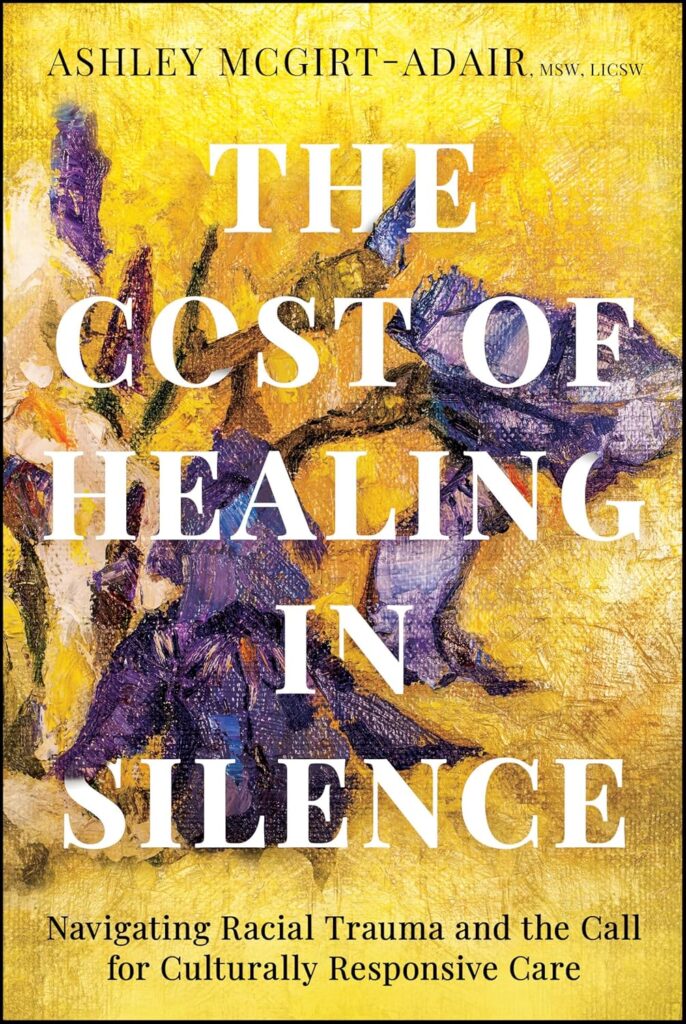
 Your upcoming book, The Cost of Healing in Silence, speaks to racial trauma. What does “healing in silence” look like, and why is it so harmful?
Healing in silence looks like carrying pain without language, support, or acknowledgment. It is minimizing your experiences, pushing through, and feeling like you have to navigate trauma on your own. It is harmful because what is unspoken often goes unaddressed, and that can show up in our bodies, our relationships, and our communities. Silence does not protect us, it often prolongs the harm.
Your upcoming book, The Cost of Healing in Silence, speaks to racial trauma. What does “healing in silence” look like, and why is it so harmful?
Healing in silence looks like carrying pain without language, support, or acknowledgment. It is minimizing your experiences, pushing through, and feeling like you have to navigate trauma on your own. It is harmful because what is unspoken often goes unaddressed, and that can show up in our bodies, our relationships, and our communities. Silence does not protect us, it often prolongs the harm.
 What are some of the most common misconceptions about racial trauma that you hope your book will challenge or reframe?
One misconception is that racial trauma is only about individual experiences of discrimination. In reality, it is also collective and systemic. It is embedded in history, policies, and everyday interactions. Another misconception is that people should just be resilient or move on. That framing ignores the ongoing nature of the harm and places responsibility on individuals instead of addressing the systems that create it.
For individuals who may not have access to therapy yet, what are some meaningful first steps they can take toward healing and self-awareness?
A meaningful first step is simply creating space to notice and name what you are feeling. That can look like journaling, talking with someone you trust, or engaging with content that helps you better understand your experiences. Community is also important. Healing does not have to happen in isolation. Even without therapy, there are ways to begin building awareness and connection.
As someone deeply immersed in this work, what practices or boundaries have you put in place to protect your own mental health and avoid burnout?
I am intentional about boundaries and rest. I do not operate in urgency, and I protect my time and energy. I also stay connected to community and practices that ground me. This work requires endurance, so I think about sustainability in everything I do. I cannot pour into others if I am depleted.
Looking ahead, what is your long-term vision for the Therapy Fund Foundation, and what systemic changes would you like to see in mental health care over the next decade?
My long-term vision is for the Therapy Fund Foundation to continue expanding access to culturally responsive care while also influencing systems. I want to see a future where cost is no longer a barrier, where there are more clinicians of color, and where mental health care is designed with equity at the center. Over the next decade, I hope to see systemic changes in how care is funded, delivered, and understood so that healing is not a privilege, but a right.
How can our readers connect?
Website | Instagram | Linkedin
What are some of the most common misconceptions about racial trauma that you hope your book will challenge or reframe?
One misconception is that racial trauma is only about individual experiences of discrimination. In reality, it is also collective and systemic. It is embedded in history, policies, and everyday interactions. Another misconception is that people should just be resilient or move on. That framing ignores the ongoing nature of the harm and places responsibility on individuals instead of addressing the systems that create it.
For individuals who may not have access to therapy yet, what are some meaningful first steps they can take toward healing and self-awareness?
A meaningful first step is simply creating space to notice and name what you are feeling. That can look like journaling, talking with someone you trust, or engaging with content that helps you better understand your experiences. Community is also important. Healing does not have to happen in isolation. Even without therapy, there are ways to begin building awareness and connection.
As someone deeply immersed in this work, what practices or boundaries have you put in place to protect your own mental health and avoid burnout?
I am intentional about boundaries and rest. I do not operate in urgency, and I protect my time and energy. I also stay connected to community and practices that ground me. This work requires endurance, so I think about sustainability in everything I do. I cannot pour into others if I am depleted.
Looking ahead, what is your long-term vision for the Therapy Fund Foundation, and what systemic changes would you like to see in mental health care over the next decade?
My long-term vision is for the Therapy Fund Foundation to continue expanding access to culturally responsive care while also influencing systems. I want to see a future where cost is no longer a barrier, where there are more clinicians of color, and where mental health care is designed with equity at the center. Over the next decade, I hope to see systemic changes in how care is funded, delivered, and understood so that healing is not a privilege, but a right.
How can our readers connect?
Website | Instagram | Linkedin
Discover more from Connected Woman Magazine
Subscribe to get the latest posts sent to your email.